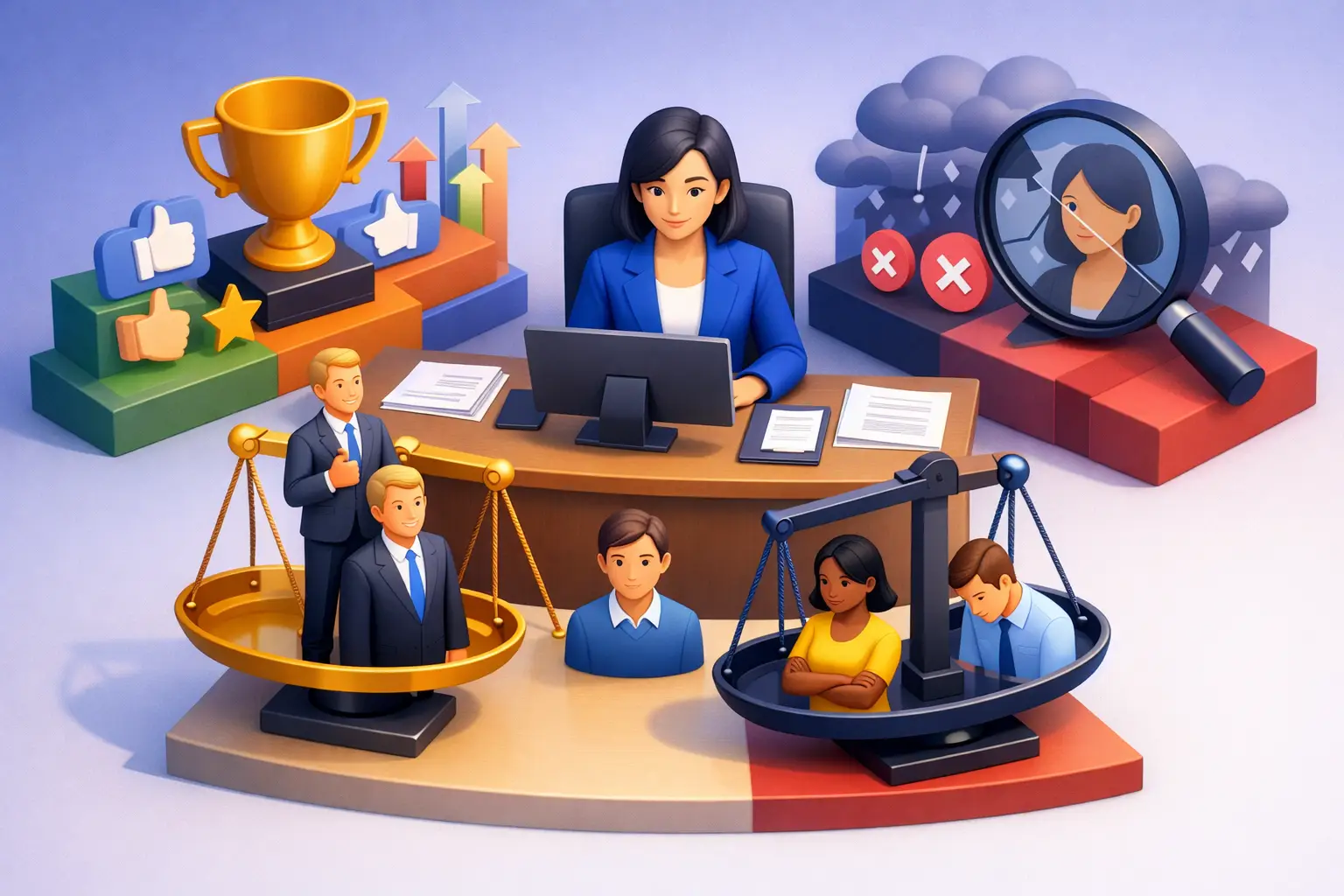
A high performer misses a promotion, not because of output, but because one manager values visibility while another rewards quiet reliability. That is usually where the real question starts: what causes bias in appraisals, and why does it keep showing up even in well-run organisations?
The short answer is that appraisal bias rarely comes from a single bad actor. It tends to come from system design, inconsistent standards, incomplete evidence, and human shortcuts taken under time pressure. If HR teams want fairer outcomes, they need to look beyond manager intent and examine how the review process itself creates distortion.
What causes bias in appraisals most often?
Most appraisal bias starts before a manager writes a single rating. It begins when role expectations are vague, performance evidence is uneven, and review criteria are interpreted differently across teams. Once those conditions exist, individual bias has room to shape the final assessment.
That matters because performance reviews are rarely just administrative exercises. They influence pay, progression, succession planning, performance improvement decisions, and employee trust. When the process is inconsistent, the organisation does not just get unfair ratings. It gets weaker talent decisions.
Vague role definitions create subjective judgement
If two employees hold the same title but perform different work in practice, standard review forms can misfire quickly. Managers end up rating against their own understanding of the role instead of a shared, current definition of responsibilities.
This is one of the most common and least discussed causes of bias. A reviewer may not be biased in the deliberate sense, but they are still making a judgement against unclear criteria. In that environment, confidence, communication style, visibility, and personal preference can carry more weight than actual contribution.
The more generic the performance framework, the more discretion managers have. Some discretion is necessary, but too much creates inconsistency that looks objective on paper and subjective in reality.
Recency bias skews the full performance picture
Managers are more likely to remember what happened in the last month than what happened nine months earlier. That makes recent mistakes or recent wins disproportionately influential.
Recency bias is especially common when review cycles rely on memory instead of documented evidence. A team member who handled critical work steadily all year can be rated lower than someone who made a visible push just before appraisal season. The issue is not necessarily dishonesty. It is that unaided recall is a poor measurement tool.
Halo and horn effects distort specific ratings
When one strong trait shapes every category in the review, the result is inflated or unfair scoring. A well-spoken employee may be rated highly across unrelated competencies because they present confidently. A single conflict or mistake may also drag down ratings in areas where performance was actually solid.
This is the classic halo or horn effect. It happens when reviewers substitute an overall impression for category-by-category evaluation. The wider the competency model and the less structured the evidence, the easier it is for this effect to take hold.
Similarity bias rewards familiarity, not performance
Managers often respond more favourably to employees who communicate like them, work in familiar ways, or share similar backgrounds and career paths. In practice, that can shape how potential, leadership, collaboration, and cultural fit are scored.
Similarity bias is particularly difficult because it can feel like accurate judgement. A manager may describe someone as dependable, strategic, or easy to work with, when what they are actually responding to is comfort and familiarity. Left unchecked, this can disadvantage employees from different backgrounds, functions, or working styles even when output is strong.
Structural reasons appraisals become biased
Bias in reviews is not only about individual perception. It is also produced by process architecture. If the workflow allows influence to enter too early, fairness drops quickly.
Manager-employee review dynamics can influence scores
In many review processes, one side sees the other person’s assessment before submitting their own. That creates a subtle but significant problem. If an employee sees a manager’s draft first, they may soften their self-assessment. If a manager sees the employee’s self-rating first, they may anchor their judgement around it.
This kind of premature visibility changes the independence of the evaluation. It does not always create overt bias, but it reduces the chances of getting two clean perspectives that can later be compared and calibrated.
Inconsistent evidence collection creates uneven outcomes
Some managers keep detailed notes. Others rely on general impressions. Some gather peer input. Others do not. Some assess delivery against goals. Others focus on attitude or responsiveness.
When evidence collection varies by manager, the organisation is no longer running one performance process. It is running dozens of local versions. That is where bias becomes embedded at scale. Even with a standard form, the underlying inputs are inconsistent, so the outputs will be too.
Calibration without structure can reinforce group bias
Calibration sessions are meant to improve consistency, but they can produce the opposite if they are poorly run. Dominant voices may set the tone. More assertive managers may defend their team more effectively. Informal reputations may outweigh documented evidence.
Without clear criteria and side-by-side comparisons grounded in actual responsibilities, calibration can become a negotiation exercise rather than a quality control process. That tends to reward confidence, seniority, and political capital instead of accuracy.
What causes bias in appraisals even when managers mean well?
Good intent does not remove cognitive bias. In fact, many biased outcomes come from managers who believe they are being fair.
A common example is overvaluing visibility. Employees who speak often in meetings or work closely with leadership may appear more impactful than employees doing critical but less visible work. Another is communication style. Direct communicators may be perceived as stronger leaders, while more reserved employees can be underrated despite equivalent results.
There is also outcome bias. A decision that led to a good result may be rated positively even if the process was poor, while a sound decision with an unlucky outcome may be judged too harshly. In performance reviews, that means the quality of thinking and execution can be overshadowed by final results alone.
These are normal human shortcuts. The operational issue is allowing those shortcuts to sit at the centre of a formal evaluation system.
How to reduce appraisal bias in practice
The most effective fix is not generic bias training on its own. Training can help awareness, but awareness without workflow control usually fades under deadline pressure. Organisations reduce bias when they redesign the points where subjectivity enters.
Start with role clarity. Review people against real responsibilities, not outdated job descriptions or broad capability statements. When expectations are specific, managers have less room to substitute preference for evidence.
Then strengthen evidence discipline across the review cycle. Short, structured check-ins and documented examples make year-end assessments more accurate than memory-based commentary. This also improves defensibility when performance decisions are challenged.
Independent submission matters as well. When self-assessments and manager reviews are completed blind and locked until both are submitted, each side is more likely to provide an unfiltered view. That creates cleaner data for comparison and a stronger foundation for calibration.
Finally, calibration needs structure. Reviewers should compare employees against role-based expectations and actual task delivery, not against whoever speaks most persuasively in the room. A side-by-side assessment model helps expose where gaps are driven by evidence and where they are driven by interpretation.
This is where purpose-built systems have a practical advantage. Platforms such as CALIBRATE are designed to reduce premature influence through blind review logic, while also using AI-supported role analysis to anchor assessments in the work people are actually expected to do. That is a more reliable control than asking managers to simply try harder to be objective.
Fairer appraisals require better system design
If your organisation is asking what causes bias in appraisals, the answer is usually not just personality, poor judgement, or isolated manager behaviour. More often, it is a process that leaves too much open to interpretation and too little grounded in shared evidence.
Bias reduces when appraisals are structured around current responsibilities, independent inputs, consistent evidence, and disciplined calibration. That does not eliminate judgement. It makes judgement more accurate.
For HR and people leaders, that is the real shift. Fairness does not come from hoping reviewers will overcome bias on their own. It comes from building a review process that gives bias fewer places to hide.