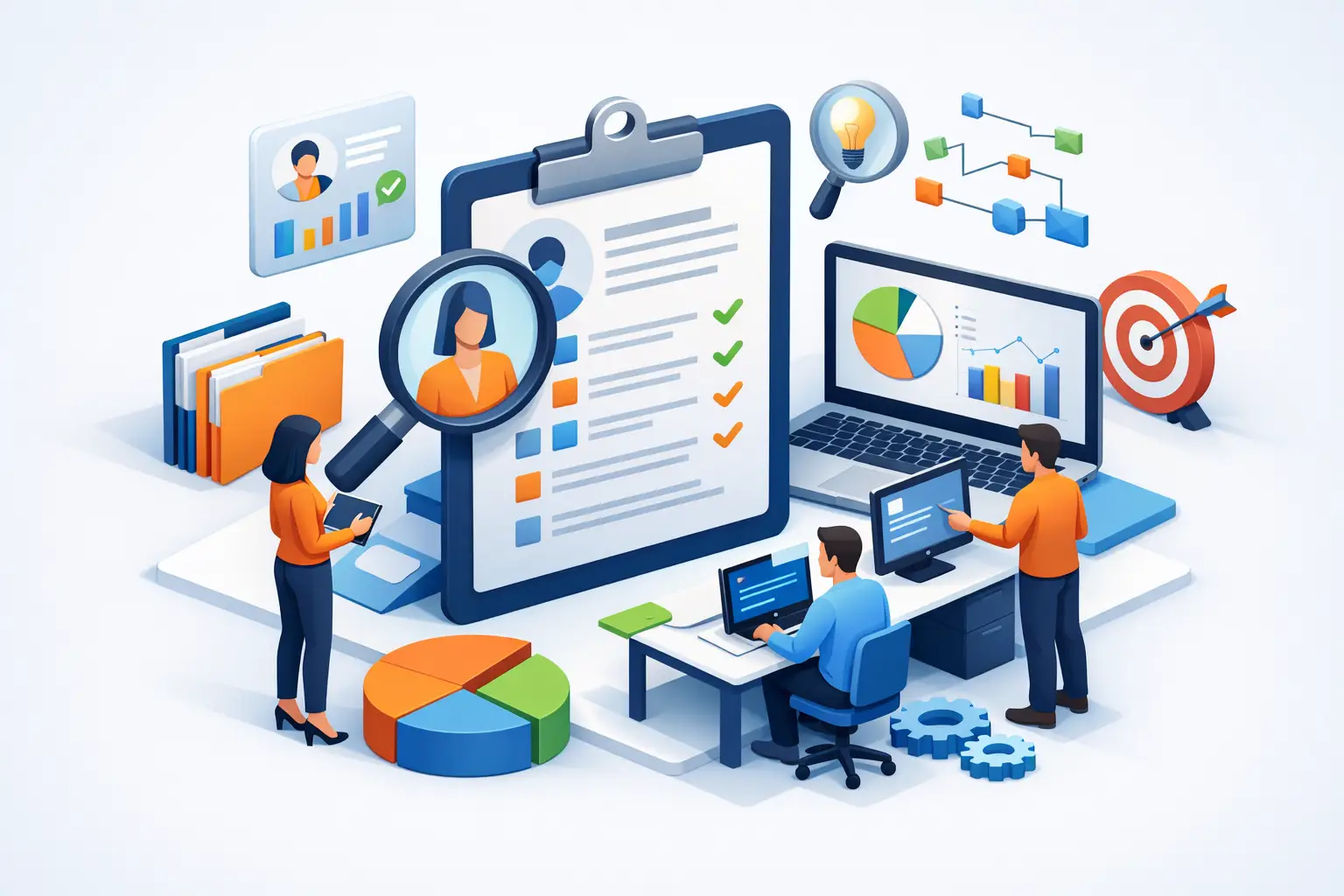
Most review problems start earlier than the review itself. They start when a position description is vague, outdated, inflated, or written for hiring rather than performance assessment. A position description analysis tool fixes that gap by turning role documents into usable evaluation criteria instead of leaving managers to interpret them differently.
For HR teams and people leaders, that matters because review quality depends on role clarity. If one manager assesses outcomes, another focuses on effort, and a third relies on memory, calibration breaks down fast. The issue is not just inconsistency. It is the absence of a shared, defensible standard.
What a position description analysis tool actually does
At its most useful, a position description analysis tool does more than scan text for keywords. It identifies the real work inside a role, separates core responsibilities from generic filler, and structures that information so it can be used in a review workflow.
That distinction is important. Many role documents contain broad statements such as "support team objectives" or "contribute to strategic outcomes". These phrases may be acceptable in a hiring ad, but they are weak inputs for assessment. A useful tool analyses the document and extracts practical responsibilities, expected outputs, and task-level themes that managers and employees can respond to directly.
This changes the review conversation. Instead of debating what the role was meant to include, both sides are working from the same mapped responsibilities. That reduces ambiguity before feedback is even written.
Why static position descriptions fail in performance reviews
Position descriptions are often treated as administrative records. They are filed, approved, and rarely revisited unless a role changes formally. Performance reviews, meanwhile, happen in a separate process with separate language. That disconnect creates predictable problems.
The first problem is drift. Over time, real responsibilities shift while the document stays the same. An employee may be carrying critical operational work that never appears in the original description. Another may still be assessed against responsibilities that are no longer central. Without analysis, HR is relying on role documentation that may not reflect the job being done.
The second problem is interpretation. Two managers can read the same position description and derive different standards from it. One may focus on leadership behaviours, another on delivery speed, and another on stakeholder management. None of those perspectives is necessarily wrong, but they are not calibrated.
The third problem is bias by omission. When a role document lacks specificity, managers fill the gaps with judgement. Sometimes that judgement is fair and well informed. Sometimes it is shaped by recency, visibility, communication style, or personal preference. The less structure the process has, the more those biases affect outcomes.
The operational value of structured role analysis
A position description analysis tool creates operational discipline. It gives HR a way to standardise how role expectations are interpreted across teams and review cycles.
That has direct value in three areas. First, it improves consistency. When responsibilities are extracted in a structured format, managers are less likely to build their own criteria from scratch. Second, it improves speed. HR does not need to manually rework every role document into review language. Third, it improves defensibility. If an employee questions the basis of an assessment, there is a clearer line between documented role expectations and scored performance.
This is especially useful in organisations with multiple business units, high manager variability, or rapidly changing roles. In those environments, traditional review forms tend to expose process weakness rather than solve it.
What to look for in a position description analysis tool
Not every tool that analyses role content is designed for performance evaluation. Some are built for recruitment, workforce planning, or skills libraries. Those use cases matter, but they are not the same as creating fair review criteria.
For performance management, the tool should produce outputs that are usable inside an assessment process. That means extracting clear responsibilities, identifying task-level expectations, and supporting consistent comparison between self-assessment and manager assessment.
It should also help control bias, not simply accelerate documentation. Speed alone is not enough if managers still influence outcomes unevenly. A stronger model pairs role analysis with structured submission controls so both parties assess against the same responsibilities before seeing each other’s responses.
This is where workflow design matters as much as AI. If the extracted responsibilities sit in a spreadsheet or static report, the process still depends on manual interpretation. If those responsibilities feed directly into a controlled assessment environment, the organisation gets a more reliable result.
Where AI helps and where it does not
AI is useful in position description analysis because it can process large volumes of role content quickly and identify responsibility patterns that would take HR teams significant time to map manually. It is particularly effective when organisations need to standardise inputs across many roles or review cycles.
But AI is not a substitute for judgement. It cannot resolve every organisational nuance on its own. If a role is poorly written, politically inflated, or carrying unofficial responsibilities, the output may still need review. That is not a failure of the tool. It is a reminder that better inputs still improve outcomes.
The practical question is not whether AI is perfect. It is whether it reduces ambiguity, admin effort, and inconsistency compared with the current process. In most organisations, the answer is yes, provided the tool is built for review accuracy rather than generic text analysis.
Why blind comparison strengthens the process
Role analysis improves the quality of the criteria. Blind comparison improves the quality of the assessment.
In many review processes, employees see cues from managers before finalising their self-assessment, or managers adjust their ratings after seeing the employee’s framing. That creates premature influence. It can soften disagreement, reinforce hierarchy, or make honest variance harder to spot.
A better system keeps both submissions locked until each side has completed its assessment against the same extracted role responsibilities. Once released, the responses can be compared side by side. This makes gaps visible without allowing either party to shape the other’s input in advance.
For HR, that is not just a fairness feature. It is a calibration feature. Differences between self-view and manager view become more meaningful when they are independently produced. That makes follow-up conversations sharper and more evidence based.
How this changes calibration across teams
Calibration often fails because managers are not actually assessing like for like. Even when rating scales match, the underlying criteria vary by team, manager style, and role interpretation. That is why cross-team comparisons can feel subjective even in a well-run review cycle.
A position description analysis tool helps create a common baseline. Roles remain distinct, but the method of extracting and assessing responsibilities becomes more consistent. When that is paired with blind, structured comparison, HR gets cleaner data and fewer distorted signals.
This is particularly valuable for promotion readiness, performance differentiation, and identifying developmental gaps. If one employee’s review is built on loosely defined expectations and another’s is tied to extracted task-level responsibilities, the outputs are not equally reliable. Standardising the input improves the integrity of the decision.
When a tool is worth implementing
The strongest case for implementation is not simply that reviews feel messy. It is that the organisation is already experiencing cost from inconsistency. That may show up as manager disputes, weak calibration sessions, employee pushback on fairness, or excessive HR effort spent rewriting role expectations for each cycle.
A smaller organisation with stable roles and highly capable managers may be able to manage without specialised tooling for longer. But once scale increases, manual interpretation becomes a risk. The break point usually arrives when HR can no longer rely on manager judgement alone to deliver consistency.
Platforms such as CALIBRATE are built for that stage. The value is not just AI extraction of role responsibilities. It is the combination of role analysis, structured self and manager assessments, and blind side-by-side comparison that reduces bias at the point where reviews usually drift.
The most useful test is simple. Ask whether your current process can explain, with evidence, why two people in similar roles received different assessments. If the answer depends heavily on manager narrative, your role criteria are not structured enough.
A position description analysis tool is not about making role documents look smarter. It is about making performance decisions more precise, more consistent, and easier to defend when scrutiny arrives. For HR leaders under pressure to improve fairness without adding administrative drag, that is a practical place to tighten the system.