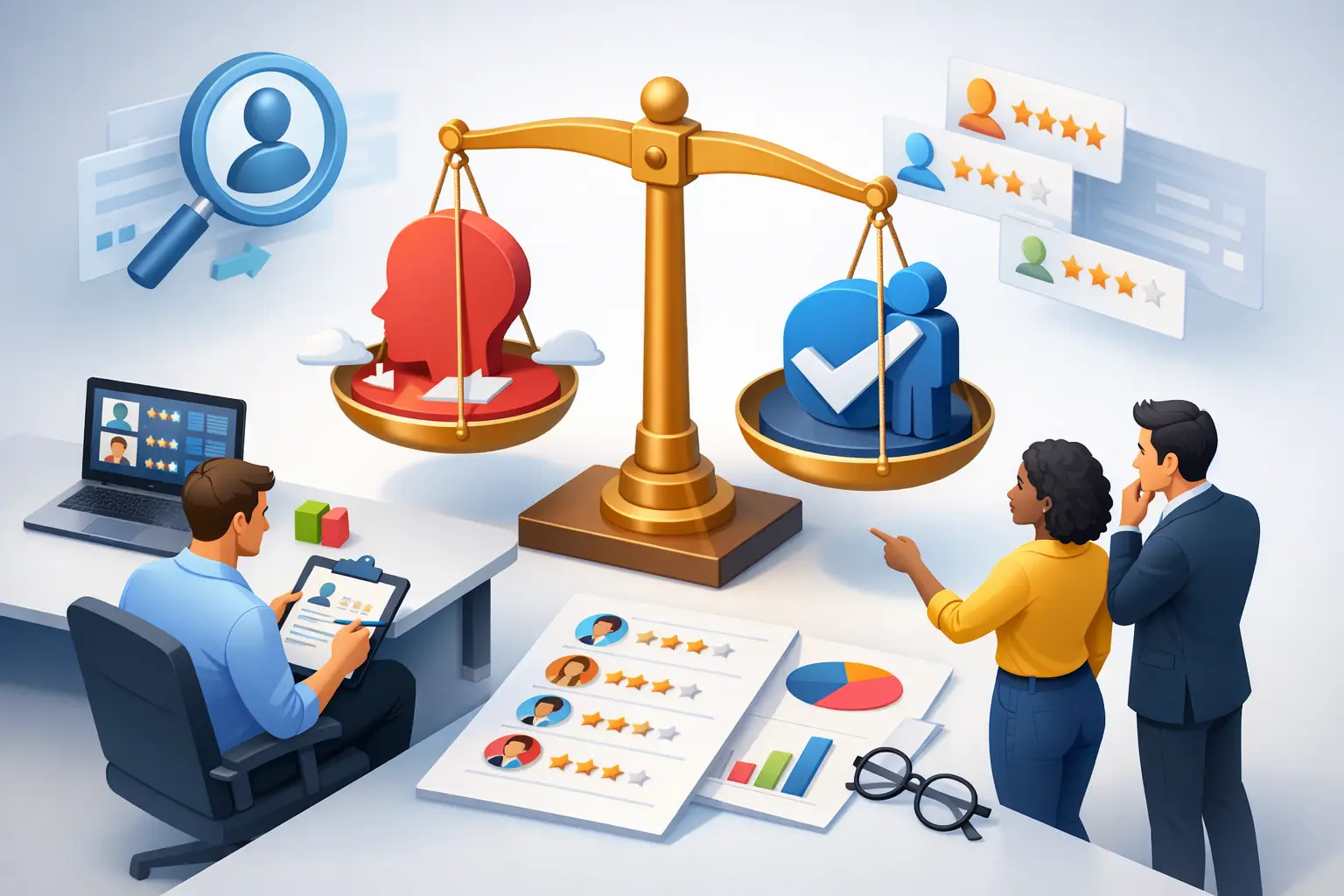
A manager rates one employee against a clear set of role expectations. Another manager rates a similar employee based on general impression, recent visibility and a difficult personality fit. Both call it performance management. This is exactly why HR teams keep asking how to reduce bias in performance reviews - because inconsistency is often built into the process, not just the people.
Bias in reviews rarely comes from bad intent. More often, it shows up through loose criteria, uneven evidence, timing effects and manager influence over employee self-assessments. If the process allows subjectivity to fill gaps, subjectivity will fill them. The fix is not a reminder to “be fair”. The fix is better review design.
Why bias persists in review cycles
Most organisations already know the common sources of bias: recency bias, similarity bias, halo and horns effects, leniency, severity and overreliance on confidence or visibility. The problem is that many review systems still make these biases easy to act on.
When role expectations are vague, managers default to personal judgement. When self-reviews are visible too early, they can anchor manager ratings. When managers assess broad traits instead of observable work, they reward style over output. And when calibration happens late, teams spend more time defending ratings than improving them.
This is why review fairness depends less on manager intention and more on process controls. Training matters, but process architecture matters more because it works at scale.
How to reduce bias in performance reviews at the system level
If you want a measurable reduction in bias, start by changing what managers are asked to evaluate and when they are allowed to see input from others.
The strongest review processes share three characteristics. They define the job clearly, require evidence against specific responsibilities and control the order in which assessments are completed. That combination reduces room for assumption, influence and inconsistency.
Start with role-specific criteria, not generic competencies
Generic review categories such as leadership, attitude or communication tend to create interpretation problems. Two managers can read the same label and apply completely different standards. That weakens comparability across teams and makes calibration harder.
A better approach is to anchor assessment criteria to the actual role. What tasks does the employee own? What outcomes are expected? Which responsibilities are core rather than optional? Once those are defined, managers can assess performance against work that was actually assigned.
This matters especially in growing organisations, where position descriptions often lag behind reality. If the documented role does not reflect the current job, reviews become distorted before they even begin. AI-assisted role analysis can help here by extracting real responsibilities from position data and turning them into structured evaluation inputs. That creates a more defensible starting point than broad behavioural labels alone.
Separate self-assessment from manager influence
One of the quieter sources of bias appears before the manager even submits a review. If managers can see self-ratings early, the employee’s framing can shape the manager’s judgement. The opposite is also true. If employees know how their manager is leaning, they may adjust their own narrative to fit it.
Blind submission logic addresses this directly. When self-assessments and manager assessments are completed independently and remain locked until both are submitted, each party provides an unprompted view. That reduces anchoring and premature alignment. It also gives HR better data because differences between self-perception and manager evaluation are visible rather than blended away.
For organisations asking how to reduce bias in performance reviews without adding more administrative burden, this is one of the highest-value process changes available. It improves review integrity without making the form longer or the workflow slower.
Require evidence at task level
Bias grows in the space between opinion and evidence. The more abstract the review question, the easier it is for a manager to rely on memory, style preference or personal comfort.
Task-level evaluation tightens that gap. Instead of asking whether someone is a “strong contributor”, ask whether they delivered the core responsibilities of the role, how consistently they met expectations and what evidence supports the rating. Observable work product creates a stronger review record and makes calibration discussions more objective.
This does not mean every role should be reduced to a checklist. Some jobs involve judgement, collaboration and influence that are harder to quantify. But even in those roles, managers can be asked to reference defined responsibilities, examples and outcomes rather than general impressions. Precision matters more than complexity.
Calibration should happen before ratings become political
Many review processes treat calibration as a final moderation step. By that stage, ratings are attached to compensation expectations, manager credibility and employee sentiment. That makes honest adjustment harder.
Effective calibration starts earlier. It begins with shared standards, comparable criteria and review inputs that can be evaluated side by side. When HR and people leaders can see how similar roles were assessed across teams, inconsistencies become easier to spot before they harden into disputes.
Use side-by-side comparisons to expose inconsistency
A common problem in traditional systems is that ratings are reviewed in isolation. A manager’s “exceeds expectations” may be another manager’s “meets expectations” for very similar work. Without comparative visibility, these differences often pass through unchecked.
Side-by-side review comparison changes that. It allows decision-makers to examine ratings, comments and role expectations together, making inflation, severity and uneven standards more visible. This is particularly useful when departments have different management styles or when new managers are still learning review discipline.
The goal is not to force identical outcomes across all teams. Some differences are legitimate because business context differs. The goal is to identify where variation reflects standards drift rather than true performance differences.
Train managers on patterns, not just principles
Bias training often stays too conceptual. Managers are told what halo bias or recency bias means, but not how those biases show up in their actual review behaviour.
A more effective approach is pattern-based training. Show managers examples of evidence-poor comments. Show where recent events outweigh the rest of the review period. Show how confidence gets confused with competence. Show how high-visibility work can overshadow essential work that is less public.
This is operationally stronger because managers can recognise the issue in context. It also creates a common language for review quality. HR should not have to explain from scratch, every cycle, why “great attitude” is not a sufficient justification for a top rating.
Process controls matter more than good intentions
The biggest mistake organisations make is treating bias as an individual flaw rather than a workflow risk. If the process permits vague criteria, exposed submissions and manager-by-manager interpretation, bias is not an exception. It is an expected output.
That is why the most reliable answer to how to reduce bias in performance reviews is to standardise decision points. Define what is being assessed. Control when inputs are visible. Compare like with like. Require evidence. Review for consistency before outcomes are final.
Technology can support this well, but only if it is designed around calibration accuracy rather than generic form completion. A platform such as CALIBRATE is useful because it applies these controls directly through AI role extraction, structured assessments and blind, side-by-side review mechanics. The value is not automation for its own sake. The value is reducing the amount of judgement that happens without structure.
What to watch for when redesigning your review process
There is a trade-off worth acknowledging. More structure improves consistency, but too much structure can make reviews feel mechanical or fail to capture nuanced contributions. The answer is not to swing back to open-text subjectivity. It is to use structured criteria for core responsibilities and allow contextual commentary where it genuinely adds meaning.
There is also an implementation question. If your managers are used to broad, narrative reviews, moving to evidence-based calibration may initially feel restrictive. That usually settles once they see that clearer criteria reduce conflict, shorten calibration meetings and produce ratings they can defend.
For HR teams, the practical test is simple. Ask whether your current process makes bias harder or easier to express. If managers can rate from memory, see others’ inputs too early or apply their own definitions of success, the system is still doing too much of the wrong work.
Fairer performance reviews do not come from asking people to be more objective. They come from building a review process where objectivity is easier to maintain than bias.