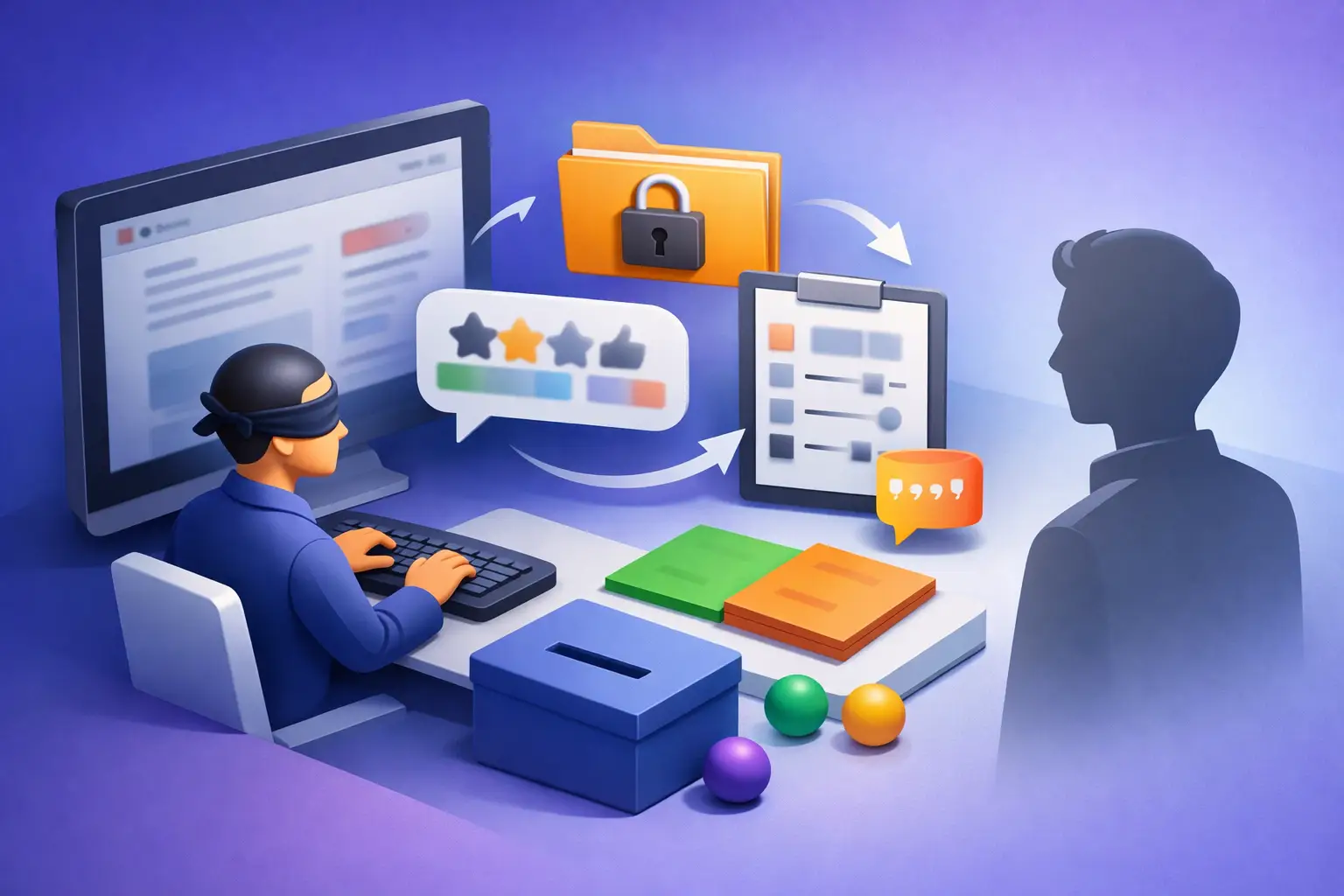
A performance review can lose value before the first conversation begins. When a manager sees an employee’s self-assessment first, it can anchor their judgement. When an employee sees manager comments early, they may tailor their response to anticipated criticism. This guide to blind feedback workflows explains how to prevent that premature influence while giving HR teams a more consistent, defensible review process.
Blind feedback is not about making performance management impersonal. It is about ensuring each participant records an independent assessment against the same role expectations before discussion begins. That distinction matters. The objective is not to remove judgement from performance reviews, but to make the judgement visible, structured and easier to calibrate.
What a blind feedback workflow actually does
A blind workflow locks review inputs until all required parties have submitted. In a manager-employee review, the employee completes a self-assessment and the manager completes their assessment independently. Neither can view or revise their response based on the other party’s comments while the review remains open.
Once submissions are complete, the system reveals the assessments side by side. The review conversation can then focus on the areas that matter: agreement, gaps in perception, evidence, priorities and next steps.
This is different from anonymous feedback. In most performance review workflows, the manager and employee know who is involved. The blind element refers to the timing and visibility of responses, not the identity of the reviewer. For 360-degree feedback, anonymity may be appropriate for peer or direct-report input, but it should be a separate design decision with clear rules around confidentiality and minimum response thresholds.
The practical benefit is straightforward. Each person commits to their view of performance before they can be influenced by the other person’s framing.
Why conventional review workflows create avoidable bias
Many review systems collect self-assessments first, then make them available to managers as they write their own evaluations. The process appears efficient, but it introduces several predictable distortions.
A detailed self-assessment can anchor a manager towards the employee’s rating, especially when the manager has limited recent evidence or manages a large team. The opposite can also occur: a manager may react against an employee’s positive framing and become more critical than they otherwise would have been. Neither outcome produces a clean assessment.
Early visibility also changes employee behaviour. If staff can see manager feedback before final submission, their responses may become defensive, overly cautious or shaped around rebuttal rather than reflection. The review becomes a negotiation before either party has stated a complete, independent position.
These effects are especially costly when the organisation is trying to make decisions about remuneration, promotion, performance improvement or succession. A weak process can create inconsistent ratings, difficult calibration meetings and a poor audit trail when leaders need to explain how decisions were made.
Build the workflow around role evidence
Blind submission controls are only effective if both reviewers are assessing the same work. Asking broad questions such as “How did this person perform?” leaves too much room for different standards, recency bias and personality-led judgement.
Start with the position description, then convert it into a practical assessment framework. The framework should identify the role’s actual responsibilities, key outcomes, expected behaviours and relevant goals. For a sales leader, that may include pipeline quality, forecast discipline, coaching effectiveness and retention. For an operations manager, it may centre on delivery performance, risk control, stakeholder management and continuous improvement.
Each assessment item should be specific enough to support evidence. A manager should be able to point to delivered work, decisions, quality indicators or observed behaviours. An employee should be able to explain their contribution, context and constraints without writing a lengthy defence.
AI-assisted task extraction can reduce the administrative effort involved in turning role descriptions into review criteria. It is useful when roles vary across teams or when position descriptions are inconsistently written. However, HR should still review the output. AI can identify likely responsibilities, but leaders remain accountable for deciding which responsibilities are material to performance in that role.
Keep ratings and comments connected
A numerical rating without context is difficult to calibrate. Comments without a rating can be difficult to compare across employees. The strongest workflow connects the two.
For each criterion, ask for a rating and a concise evidence-based comment. Require reviewers to explain unusually high or low ratings, rather than demanding a paragraph for every item. This creates useful data without turning the review into a writing exercise.
Use a consistent rating scale across comparable groups. A five-point scale can work well when each point has a clear definition, but the scale itself is less important than disciplined interpretation. If one manager treats “meets expectations” as excellent and another treats it as barely adequate, blind workflows will reveal independent views but cannot solve the underlying calibration problem.
Set the rules before the review opens
A reliable blind feedback workflow needs clear operating rules. Define who completes each assessment, what is visible during the submission period, when the assessments unlock and who can reopen a review after submission.
For most manager-employee reviews, both parties should be able to save drafts but not see the other’s work. Once submitted, a response should remain locked unless HR or a designated administrator reopens it. This prevents quiet post-submission edits that weaken the integrity of the comparison.
Set a realistic review window and use reminders selectively. A short deadline can improve completion rates, but it can also encourage rushed responses during a busy operating period. For a team with complex roles or limited manager capacity, a longer window with staged reminders is usually more effective.
There should also be an escalation path for non-completion. If a manager is on leave or an employee has changed reporting lines, HR needs a documented decision on who owns the assessment. Exceptions are normal. Unstructured exceptions are where fairness problems begin.
Use the side-by-side comparison to run better conversations
The comparison screen is where blind feedback becomes operationally useful. Rather than reading two separate documents, the manager and employee can see where ratings and comments align or diverge against each responsibility.
Agreement should not be ignored. It confirms shared expectations and can identify strengths worth building on. The most productive discussion, however, often sits in the gaps. A manager may rate stakeholder management lower because key updates were late, while the employee may point to unclear decision rights or competing project deadlines. Both perspectives can be valid, and the conversation can move towards evidence and practical changes.
Managers should avoid treating a rating gap as proof that one person is wrong. A gap is a signal to investigate. Ask what evidence each person used, whether the role expectation was understood, and whether the assessment covers the same period of work. This approach produces more accurate outcomes than forcing immediate agreement.
The meeting should end with defined actions, not just a final rating. Depending on the result, that may mean clarifying priorities, setting measurable goals, arranging targeted development or documenting support required from the manager. When there is a meaningful performance concern, record the expected standard, timeframe and review points with precision.
Calibrate after independent assessments are complete
Team-level calibration should occur after managers have submitted independent reviews, not before. Pre-review discussions can be useful for explaining standards, but managers should not negotiate individual ratings before recording their initial judgement. That practice can create groupthink and obscure whether a manager’s assessment is genuinely evidence-based.
In calibration sessions, compare employees doing similar work or operating at similar levels. Look for rating patterns, inconsistent standards and unexplained outliers. A manager who rates every employee highly may need the same scrutiny as a manager who rates everyone harshly.
Do not force a bell curve simply because one has been used historically. Performance distributions differ across teams, role types and business periods. Calibration should test the quality of evidence and consistency of standards, not manufacture a predetermined spread of results.
A platform such as CALIBRATE can support this process by extracting role responsibilities, locking manager and self-assessments until submission, and presenting results for structured comparison. The value is not the lock alone. It is the combination of role-based criteria, independent inputs and clearer manager discussion points.
Measure whether the workflow is improving review quality
Completion rate is necessary, but it is not a quality measure. Track how often manager and employee ratings materially differ, which criteria generate the largest gaps, how often reviews are reopened, and whether managers provide sufficient evidence for significant ratings.
Over time, these patterns show where the process needs adjustment. Frequent disagreement about priorities may indicate unclear role design. Large rating variation between managers may point to inconsistent standards. Repeatedly generic comments may mean the assessment questions are too broad or managers need more guidance.
Blind workflows should be reviewed after each cycle. The aim is not to add controls for their own sake. It is to remove the points where influence, ambiguity and inconsistent evidence distort a decision that affects people’s work and progression.
A well-designed blind feedback process gives both employees and managers a fairer starting point: independent views, visible evidence and a conversation focused on the work rather than who saw what first.