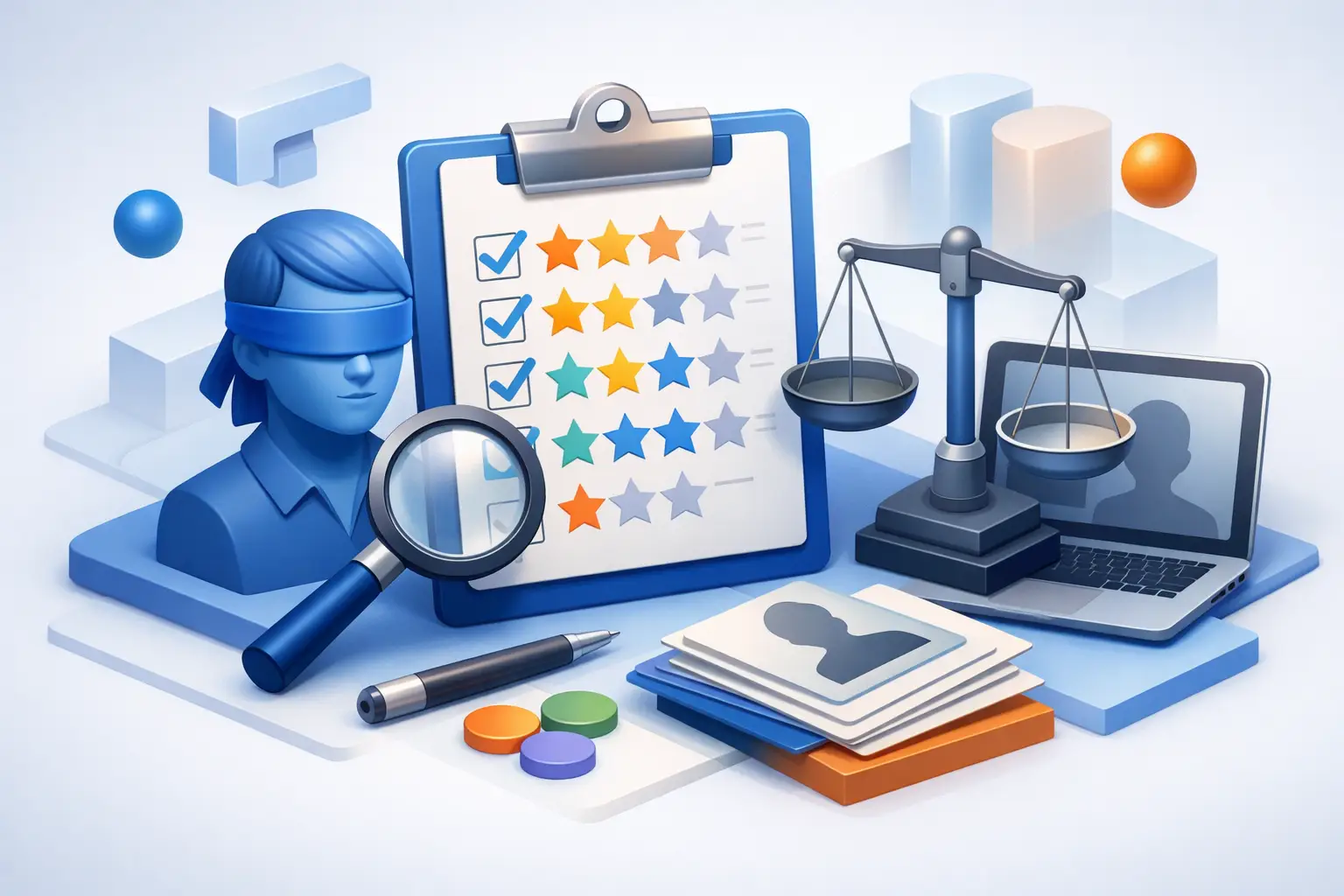
Performance reviews often go off course before the conversation even starts. When a manager can see an employee’s self-ratings too early, or an employee shapes responses around expected manager feedback, the process stops being an independent assessment. A blind self assessment tool is designed to prevent that problem by keeping inputs separate until both sides have submitted.
For HR teams and people leaders, that control is not a minor workflow preference. It affects calibration quality, perceived fairness, and how defensible review outcomes are when decisions touch pay, promotion, succession, or performance improvement. If the goal is a more accurate read on performance, blindness is a structural requirement, not a nice extra.
What a blind self assessment tool actually does
A blind self assessment tool allows employees to complete a structured review of their own performance while managers complete a separate assessment against the same criteria. Neither side can view the other’s responses before submission. Once both assessments are complete, the system reveals them side by side for direct comparison.
That sequence matters. Traditional review software often treats self-assessments as pre-reading for managers. On paper, that sounds collaborative. In practice, it can anchor the manager’s judgement too early or encourage the employee to write for persuasion rather than accuracy. A blind model keeps both views independent until the right stage of the process.
For organisations trying to reduce bias and tighten review discipline, the value is straightforward. You get two cleaner data points before discussion begins. That improves the quality of the calibration conversation because differences are surfaced rather than softened in advance.
Why blind review logic improves calibration
Most review processes struggle with three recurring issues: inconsistent standards, inflated self-ratings, and manager bias. None of these disappear just because a form has been digitised. In some systems, poor design simply makes them easier to scale.
A blind self assessment tool improves calibration by controlling when influence can happen. Employees assess their work against defined responsibilities, goals, or task-level expectations. Managers do the same independently. When results are revealed together, the comparison highlights where agreement exists and where interpretation differs.
That is where calibration becomes more useful. Instead of debating broad impressions, reviewers can examine specific gaps. Did the employee overestimate impact on a core responsibility? Did the manager underrate delivery on a task that sat outside the most visible team outputs? Those are much more productive questions than a vague conversation about whether someone is "meeting expectations".
Blindness does not remove bias on its own. If the criteria are weak, the data will still be weak. But it does reduce premature influence, which is one of the most common and least controlled distortions in performance reviews.
The difference between blind and standard self-assessments
A standard self-assessment process usually works like this: the employee submits first, the manager reads it, then completes their assessment. That creates an immediate dependency. The manager may consciously adjust around the employee’s explanation, or react against it. Either way, the employee’s submission has already changed the review path.
With a blind model, the sequence is more disciplined. Both parties work from the same framework, but they do so independently. The discussion happens after both assessments are locked. That does not make the process less collaborative. It makes collaboration occur at the right point - after judgement, not during it.
For HR, the distinction is operationally significant. If your aim is fairness, consistency and stronger calibration, independent submission gives you a cleaner basis for comparison. If your aim is simply to collect comments, then blindness may feel unnecessary. The right choice depends on whether the organisation treats reviews as evidence-based evaluation or informal manager commentary.
What to look for in a blind self assessment tool
Not every platform that includes self-assessments is built for blind review control. The label can be used loosely, so it helps to look past feature lists and focus on how the workflow is enforced.
The first requirement is true submission locking. A tool should prevent either party from viewing the other’s responses until both have completed their assessments. If one side can preview partial content, edit after seeing the other submission, or bypass the lock through admin settings, the blind model is compromised.
The second is structured assessment design. Blind comparison works best when both parties are rating against the same responsibilities, goals and performance criteria. Generic text boxes create noise. A stronger system anchors the review in actual role requirements and specific task-level expectations.
The third is side-by-side comparison after submission. Once both assessments are complete, the value comes from seeing alignment and variance clearly. If the output buries differences in separate screens or long narrative summaries, managers lose the calibration advantage.
The fourth is role clarity. Reviews are more reliable when the assessment criteria reflect what the person is actually expected to do, not a generic job title. This is where AI-assisted extraction of role responsibilities can materially improve review quality by turning position information into usable evaluation structure.
A platform like CALIBRATE is built around that logic: structured role analysis, blind submission controls, and direct comparison designed for calibration rather than a generic annual review workflow.
Where blind self-assessment works best
This approach is especially effective in organisations where review quality affects broader talent decisions. That includes promotion rounds, high-potential identification, performance remediation, and any environment where multiple managers need to compare employees across teams.
It is also useful where role complexity creates uneven visibility. In many teams, employees do meaningful work that a manager only sees partially. A blind self-assessment gives the employee room to document delivery and impact without immediately shaping the manager’s rating. When both views are revealed together, differences can be tested against evidence rather than hierarchy.
That said, a blind model is not always necessary for every check-in. For lightweight fortnightly or monthly conversations, strict review controls may be excessive. The strongest use case is formal assessment, where accuracy and consistency matter more than conversational ease.
Implementation trade-offs HR teams should consider
A blind self assessment tool improves rigour, but it also changes behaviour. That is usually a benefit, though it can feel unfamiliar at first.
Managers who are used to reading self-assessments before writing their own may see the process as less efficient. In the short term, they may need tighter guidance on rating standards and evidence expectations. Employees may also need clearer instructions, especially if they have previously treated self-assessments as advocacy documents rather than objective performance records.
There is also a design trade-off. The more structured the assessment, the easier it is to compare results. But excessive rigidity can flatten nuance, particularly in roles with evolving responsibilities. The answer is not to remove structure. It is to combine structured criteria with enough room for context, examples and goal-based commentary.
Adoption depends on trust as much as process. If employees believe blind review is simply another way to catch discrepancies, they may resist it. If HR positions it correctly - as a fairness control that protects independent judgement on both sides - the process is much easier to land.
How to assess whether your current process needs a blind tool
A simple test is to look at your review outcomes and ask where distortion enters the process. If self-ratings and manager ratings are routinely too similar without clear evidence, early visibility may be driving convergence. If managers complain that self-assessments are defensive or political, the current format may be encouraging impression management. If calibration meetings depend heavily on anecdote, your underlying assessments may lack structure.
You should also examine whether role expectations are consistently defined before reviews begin. Blind comparison is most valuable when both parties assess against the same understood responsibilities. Without that baseline, disagreement may reflect ambiguity rather than performance.
The best blind self assessment tool is not the one with the longest feature list. It is the one that makes independent assessment, structured comparison and fairer calibration part of the default workflow.
Reviews do not become more objective because people intend them to be. They become more objective when the system removes avoidable influence and makes comparison easier. If your organisation wants more defensible performance decisions, start by fixing the point where bias enters earliest - before either side sees the other’s view.