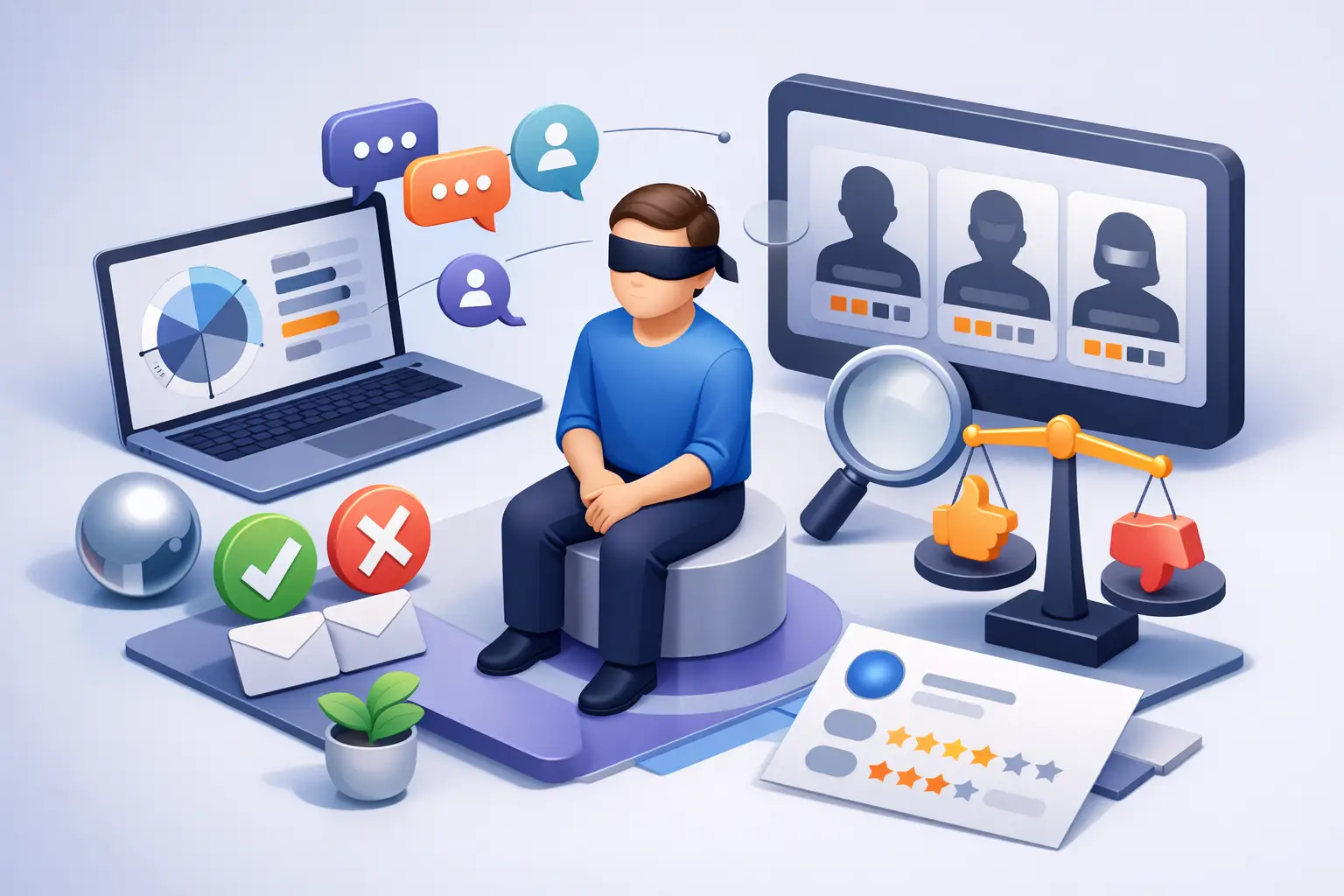
When a manager can see an employee’s self-rating before submitting their own assessment, the review is already shaped. Sometimes subtly, sometimes materially. That is the core problem blind 360 review software is built to fix.
For HR teams and people leaders, this is not a minor workflow preference. It affects rating consistency, calibration quality and the credibility of performance decisions. If review inputs are influenced too early, the final outcome may look aligned on paper while masking bias, hesitation or score inflation underneath.
What blind 360 review software actually changes
Traditional performance review systems tend to collect feedback in one place and reveal it as it arrives. That sounds efficient, but it introduces a predictable risk. Once one party sees the other’s responses, independence is lost.
Blind 360 review software changes the order of operations. Self-assessments and manager assessments are completed separately and remain locked until both sides submit. Only then can the responses be compared side by side.
That single control has a practical effect. Employees are more likely to rate their own work honestly rather than trying to match an expected manager view. Managers are more likely to assess performance against actual evidence rather than adjusting to an employee’s framing. HR gets cleaner data because each input was made without premature influence.
The value is not just in hiding responses. It is in preserving independent judgement until the right moment.
Why conventional 360 processes create avoidable bias
Most review systems were designed to collect feedback, not necessarily to protect the integrity of feedback. As a result, many organisations run into the same issues every cycle.
One issue is anchoring. If a manager reads a polished self-review first, their assessment can shift towards that narrative even when the employee’s actual delivery was mixed. The reverse is also true. If employees know how a manager tends to score, they often calibrate their self-ratings defensively.
Another issue is uneven confidence. Strong communicators often present their work more effectively than quieter performers. In an open review sequence, that can distort the discussion before evidence is fully tested. Blind review controls do not remove interpersonal dynamics altogether, but they stop those dynamics from shaping the initial submission.
Then there is administrative inconsistency. Different departments interpret criteria differently, which makes calibration harder later. If the software only collects broad comments and generic ratings, HR ends up trying to standardise outcomes after the fact. That is expensive and often politically difficult.
What good blind 360 review software should include
Not every platform that claims to support 360 reviews is designed for blind assessment. In practice, the difference comes down to workflow controls and assessment structure.
The first requirement is true submission lock logic. Reviews should remain hidden until both parties complete their assessment. Partial visibility defeats the point.
The second is side-by-side comparison after release. Once both submissions are in, managers and HR need a clear way to compare self-view and manager-view across the same criteria. If this comparison is buried in separate screens or exported spreadsheets, the workflow slows down and important gaps are missed.
The third is structured evaluation against actual role responsibilities. Generic competency templates can be useful, but they rarely solve the precision problem. If an employee is being assessed against broad traits rather than the real tasks and accountabilities of the role, blind scoring still produces weak data.
This is where AI can add operational value. Software that can ingest a position description and extract practical role responsibilities gives reviewers a better framework from the start. Instead of debating vague concepts, they assess delivery against defined expectations.
Finally, the system needs calibration readiness. That means rating consistency, comparable criteria across similar roles, and outputs that support review moderation. Blind input is helpful, but on its own it is not enough. The downstream calibration process still needs structure.
Where blind review software has the biggest impact
The biggest gains usually show up in organisations that already know their review process is producing noise. HR can often spot the signs quickly: inflated ratings in one team, overly harsh scoring in another, self-assessments that read like advocacy documents, and moderation meetings that spend more time debating perceptions than evidence.
Blind 360 review software is particularly useful in three situations.
The first is when manager quality varies. Some managers are disciplined reviewers. Others avoid hard conversations or overcorrect late in the cycle. Blind submission controls reduce the extent to which those habits distort the first round of assessment.
The second is when organisations are growing. As headcount increases, informal review habits stop scaling. Teams need consistent inputs if performance decisions, promotions and development plans are going to hold up across the business.
The third is when review credibility has already been questioned. If employees believe outcomes are shaped by personality, timing or politics, trust drops quickly. A more controlled process does not solve every trust problem, but it gives HR a more defensible foundation.
The trade-off: structure versus flexibility
There is a trade-off, and serious buyers should be clear about it. Blind 360 review software introduces more process discipline. That is the point, but it can feel more rigid than a lightweight review form.
For some organisations, especially smaller teams with strong manager capability and simple review needs, a fully structured blind workflow may be more than they need immediately. If the main issue is just documentation, simpler tools might be enough.
But when fairness, auditability and calibration quality matter, flexibility is often overrated. A review process should not be loose simply because people are used to it. It should be designed to produce reliable judgements.
The right question is not whether blind review software adds structure. It is whether that structure improves the quality of decisions that follow.
How to assess blind 360 review software properly
A software demo can make almost any review platform look capable. The better test is to focus on mechanism, not marketing.
Ask how the blind logic works. Can either party see anything before both submit? Can HR configure release rules? Is the lock applied at the full review level or only to selected fields?
Then look at assessment design. Does the system support role-specific criteria, or does it push every team into the same generic framework? Can it translate job information into practical review dimensions? If not, you may simply be collecting cleaner bias inside an imprecise model.
Next, inspect the comparison view. Side-by-side analysis should be immediate and readable. Managers should be able to see where self-assessment and manager assessment align, where they diverge, and which gaps require discussion.
Finally, consider rollout. HR teams do not just need a feature set. They need a process that departments will actually use. The strongest platforms make the review experience straightforward for employees and managers while still giving HR tighter control over consistency and calibration.
This is also where a product such as CALIBRATE stands apart. Its model centres on blind, side-by-side review, task-level assessment and AI-assisted role analysis rather than generic annual review administration.
Why the best systems focus on calibration, not just collection
A 360 review is only useful if it supports better judgement. That means the software should help the organisation move from raw feedback to comparable, fair and evidence-based decisions.
Collection is easy. Most systems can gather forms. The harder problem is producing assessments that are independent, structured and suitable for moderation across teams. Blind review controls matter because they improve the quality of the raw material. Role-based criteria matter because they make scoring more defensible. Side-by-side comparison matters because it turns disagreement into something visible and discussable.
For HR leaders, that combination is where operational value sits. It shortens debate cycles, reduces avoidable rating drift and gives people leaders a stronger basis for development conversations.
If your review process already feels too subjective, blind 360 review software is not just another feature category to evaluate. It is a decision about whether performance assessment in your organisation should be influenced by timing and personality, or governed by structure and evidence. That is usually where better reviews start.