A manager’s rating can change the entire direction of a performance conversation before it starts. Once an employee sees that rating, their self-assessment may become a defence of the gap rather than an honest account of their work. That is why the distinction between 360 feedback vs blind reviews matters. They solve different problems, and treating them as interchangeable leaves avoidable bias in the review process.
360 feedback broadens the evidence base by collecting perspectives from multiple people. Blind reviews control when key assessments become visible. A mature performance process may use both, but HR and people leaders need to understand where each method adds value, where it creates operational risk, and how to structure the workflow around actual role responsibilities.
360 Feedback vs Blind Reviews: The Core Difference
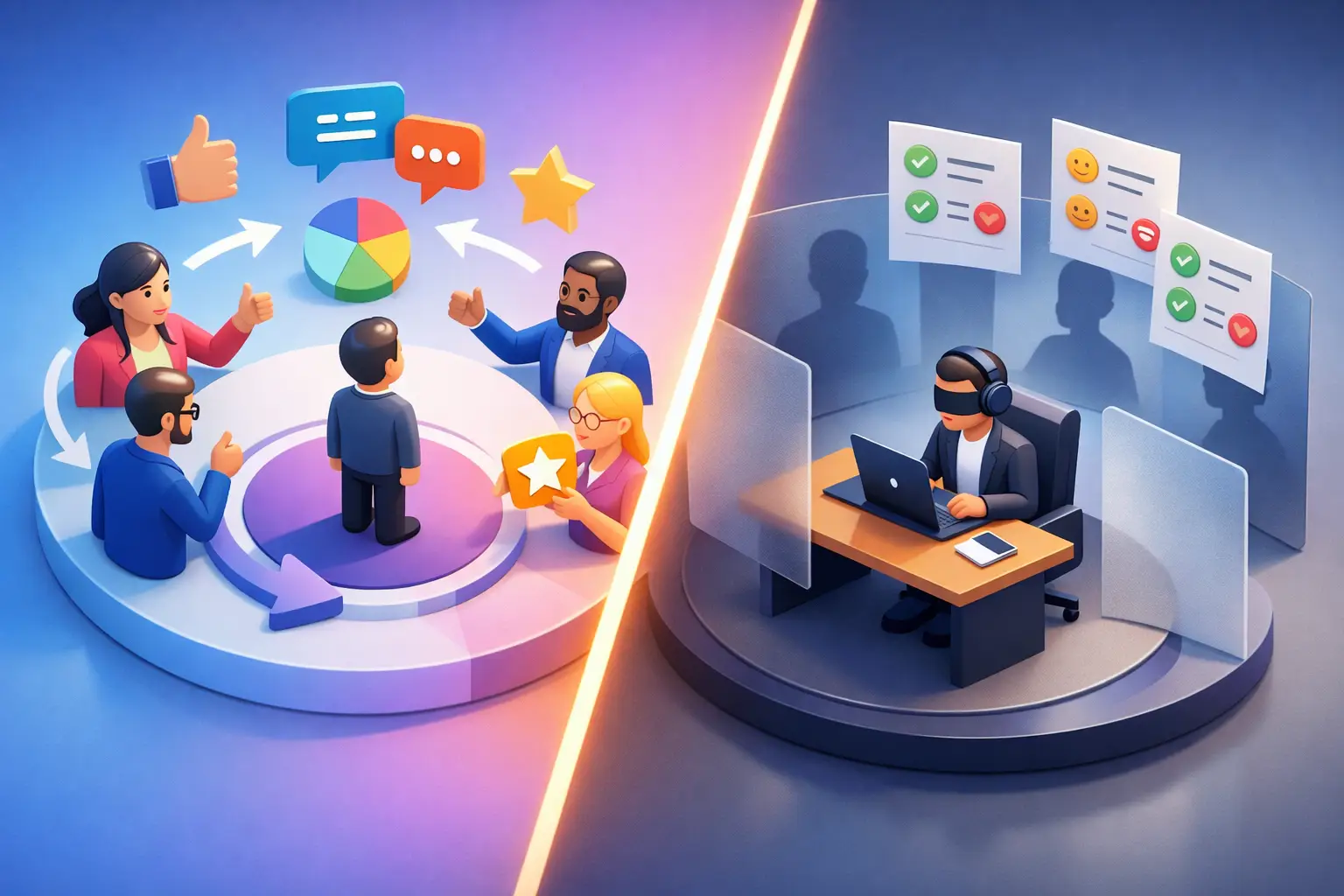
360 feedback is a feedback collection model. Employees receive input from a range of contributors, commonly their manager, peers, direct reports, project stakeholders and sometimes customers. The purpose is to build a fuller picture of behaviour, collaboration and leadership impact than one manager can reasonably observe.
Blind reviews are a submission control. In a blind review process, one party cannot view the other party’s assessment until both have submitted. The most useful application is usually a locked, side-by-side self-assessment and manager assessment. Each person evaluates performance against the same criteria independently, then the system reveals both views for discussion.
This is not a minor workflow detail. It changes the order of influence. In an ordinary review, a manager may complete their assessment first and the employee can often see, infer or react to it before finalising their own comments. Alternatively, a manager may read the employee’s self-review before assigning ratings, allowing confidence, writing quality or personal rapport to affect their judgement. Blind submission removes that early signal.
The practical distinction is straightforward: 360 feedback answers, “Whose perspective should inform this review?” Blind reviews answer, “How do we prevent one assessment from shaping another before it is independently recorded?”
What 360 Feedback Does Well
A well-designed 360 process is valuable when performance depends on relationships that a direct manager cannot fully observe. This is common in matrix organisations, professional services, product teams and leadership roles. A project lead may deliver work across several teams, while a manager sees only a portion of the stakeholder management, decision-making and follow-through involved.
Multiple perspectives can identify patterns that individual observations miss. If several project partners independently describe unclear handovers, for example, that is more actionable than a single vague comment about communication. Similarly, feedback from direct reports can reveal whether a manager’s leadership style creates clarity, accountability and psychological safety in day-to-day work.
360 feedback also reduces the risk that one manager’s limited exposure becomes the sole record of performance. That matters when managers have changed mid-cycle, teams work remotely, or delivery is distributed across functions.
However, more feedback is not automatically better feedback. Unstructured 360 programmes often create a volume problem rather than an evidence problem. Contributors may rate traits they cannot directly observe, provide generic commentary, or let a single positive or negative experience dominate their response. Anonymous feedback can encourage candour, but it can also produce vague criticism with limited accountability.
For this reason, 360 feedback works best when questions are tightly connected to observable behaviours and the contributor has a clear relationship to the employee’s work. It is particularly effective for development, leadership capability and cross-functional effectiveness. It is less reliable as the sole basis for pay, promotion or formal performance decisions.
Where Blind Reviews Improve Review Quality
Blind reviews are designed for a narrower but high-stakes problem: independent judgement. They are most effective where employees and managers must assess achievements, responsibilities, goals and performance levels against an agreed framework.
The locked submission model prevents premature influence in both directions. Employees cannot tailor a self-review around a manager’s rating. Managers cannot unconsciously anchor on how confidently an employee has presented their own performance. Both must commit to their view before the comparison is available.
That comparison then becomes useful evidence. Agreement can confirm shared expectations and clear performance standards. Gaps are equally valuable because they expose the work that needs discussion. A manager may rate a responsibility as consistently delivered while the employee identifies recurring blockers, unrecognised effort or unclear priorities. An employee may believe a goal was achieved, while the manager sees a shortfall in quality, timing or stakeholder impact.
Neither view should automatically win. The point is to make the difference visible, specific and discussable. A blind review changes the meeting from a rating announcement into a calibration conversation.
Blind processes also create a stronger audit trail. HR teams can see that ratings and comments were submitted independently, rather than retrospectively adjusted after one party viewed the other’s position. For organisations seeking consistent, defensible performance decisions, that sequence matters.
The Trade-offs HR Teams Need to Manage
Blind reviews do not eliminate bias. They prevent one form of influence, but managers may still bring recency bias, halo effects, inconsistent standards or incomplete evidence to their assessment. An employee may overrate their contribution, understate it, or focus on work that was visible rather than valuable.
The quality of the criteria remains decisive. If the review form asks broad questions such as “How did this person perform?”, blind submission simply preserves two independent but potentially vague opinions. If it asks both parties to assess actual role responsibilities, agreed goals, outcomes, evidence and development areas, the resulting comparison is far more useful.
360 feedback has its own trade-off. It adds administrative work for HR, contributors and managers. Asking too many people for feedback can create survey fatigue and slow the review cycle. Asking too few can make the process appear selective or political. Contributors need enough context to provide credible input, and managers need guidance on how to interpret feedback without treating every comment as fact.
There is also a confidentiality decision. Anonymous 360 feedback may encourage contributors to be frank, especially where there is a power imbalance. Named feedback can improve accountability and allow direct follow-up. The right approach depends on organisational maturity, team size and the nature of the feedback sought. It should be deliberate, not inherited from a default system setting.
A Better Model: Structured 360 Input, Blind Core Assessment
For many organisations, the strongest approach is not choosing between the two methods. It is assigning each method a clear job.
Use structured 360 feedback to gather targeted evidence on collaboration, leadership and stakeholder impact. Keep the contributor group relevant and the questions focused on observable actions. Then use a blind self-assessment and manager assessment as the core performance record, with both parties assessing the same responsibilities and goals before either can see the other’s response.
The sequence matters. Role expectations should come first. Performance evidence should sit against those expectations. Third-party input should add context, not replace accountable manager judgement. The locked comparison should reveal alignment and gaps before the conversation, giving the manager a precise agenda rather than a page of generic feedback to interpret live.
This model is especially useful where position descriptions are outdated or overly broad. If employees and managers are evaluating different versions of the role, no amount of feedback collection will produce fair calibration. AI-assisted extraction of practical role responsibilities can provide a more consistent starting point, translating job documentation into reviewable tasks and responsibilities. CALIBRATE applies this approach alongside blind, side-by-side assessments so managers can focus on the areas where evidence and perception differ.
Questions to Ask Before Selecting a Review Method
The decision should begin with the performance question, not the feature list. If the organisation needs to understand how a leader is experienced across teams, 360 feedback is likely necessary. If it needs to reduce early influence between an employee and their manager, blind submission is the more direct control.
HR leaders should also ask whether the organisation has consistent role criteria, whether managers can access relevant evidence, and whether the outcome will affect remuneration or promotion. High-consequence decisions require more structure, clearer documentation and careful calibration across managers. Development-focused feedback can allow more qualitative input and broader contributor groups.
A review process becomes credible when people can see how the conclusion was reached. That means defined responsibilities, independent assessments, relevant evidence and a conversation that deals with real differences rather than papering over them. The most useful performance system is not the one that collects the most opinions. It is the one that makes fairer judgement easier to repeat.